Wednesday, July 3, 2013

Day 8 French Hospitality


 What a delight to arrive in the northern coastal region of Brittany and to be met at the train station by a friend we met in Australia. Diane was a gap student at Wendy’s school and she has invited us to stay at her home with her parents. We are welcomed like family and warmly embraced into a charming home.

Dinner at the family table begins with vegetable soup made with radish leaves, main course is farm raised chicken broiled in tomato and served with French lentils. Dessert is homemade lemon meringue pie. Somewhere there is also time to savour three wonderful cheeses from various regions of France plus some homemade apple cider. Delicious! Thank you, Corinne.

Richard is delighted to meet his host, Frederic, a fellow organic gardener whose strawberries, raspberries and gooseberries are sweet and flavoursome.

The day ends with a walk around the walls of the old port city of St Malo. The statues and monuments of local heroes, who made their fortunes as pirates, make sense to Aussie travellers used to the adoration of bushrangers. On cue a magnificent tall ship sails into the harbour as the sun sets across the Atlantic at about 10pm.  

Tuesday, July 2, 2013

Day 7 Politicians can make a difference


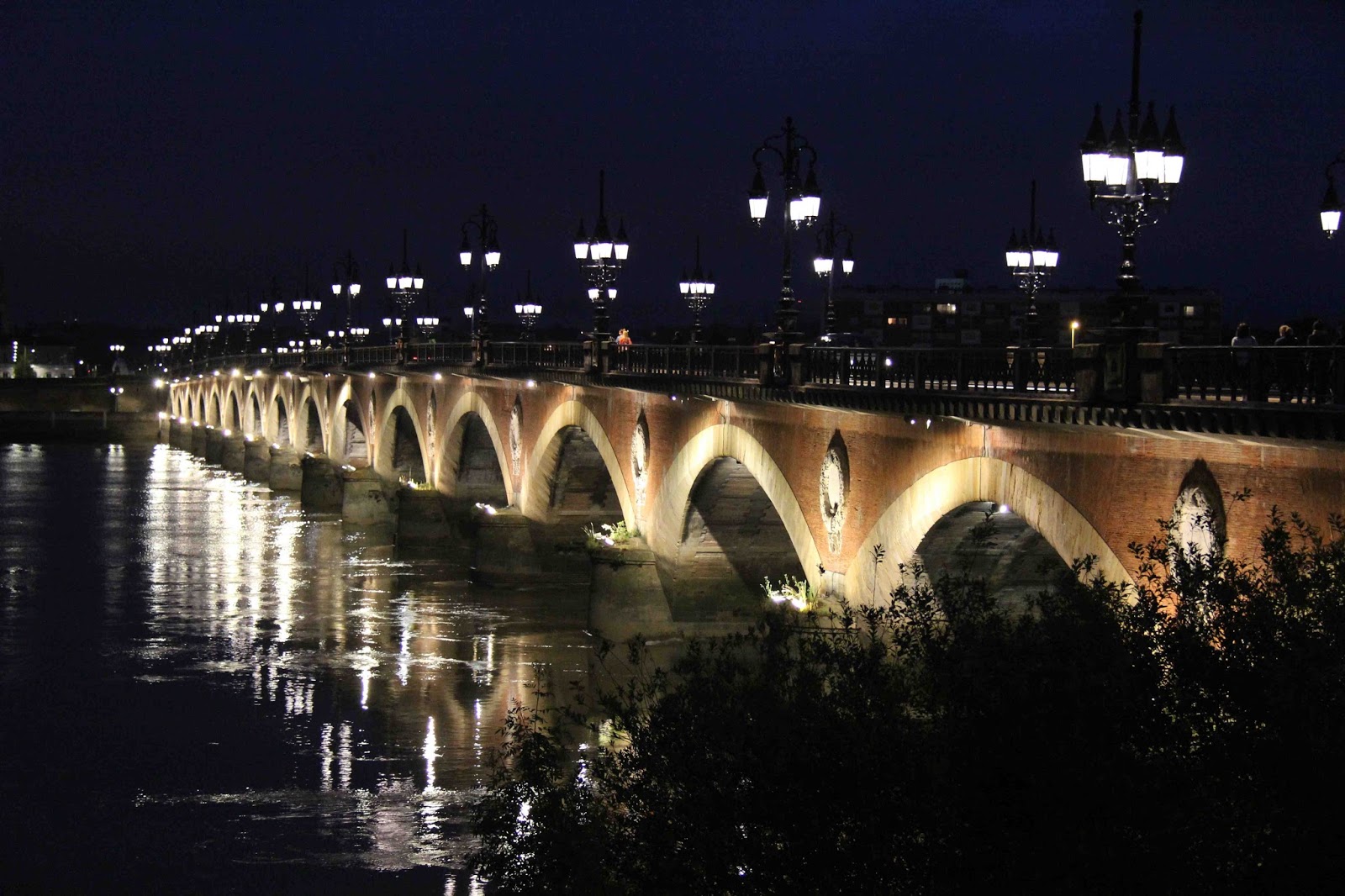
It’s tempting to believe all politicians are only interested in promoting their own ambitions. The city of Bordeaux proves that this is not always the case. A dozen or so years ago the mayor of Bordeaux and former Prime Minister Alain Juppe determined that Bordeaux needed a makeover. With a major infrastructure investment Bordeaux pedestrinanised its boulevards, restored its neo-classical architecture and introduced a system of functional, attractive, wireless trams. With the glory of the Garonne riverfront, bridges old and new, a glorious botanic gardens and the longest shopping 
street in Europe we find it hard to drag 
ourselves away. But we do!

By mid afternoon we head west to the seaside town of Arcachon. Not quite South West Rocks but there is sand, sun, sea and quite a few rather aged topless bathers. We stroll along the pier, take off our shoes and paddle in the surprisingly warm water. Later we enjoy an ice cream at the shop where the longest queue is an accurate indication of the highest quality.

By early evening we head back to Bordeaux and then in the opposite direction to the medieval village of St Emilion. Sensibly the crowds have gone home and we explore what could almost be described as a wine lovers theme park. Surprisingly and accidentally we witness the filming of a TV commercial where a ballerina on a suspended steep cable appears to fly over the ancient buildings.

We are so busy enjoying the sun that we almost forget to eat. In fact what we end up eating, very late that evening, is quite forgettable.

Monday, July 1, 2013

Day 6 Why travel by train?


Day 6 includes a long train journey from Aix-en-Provence, via Marseilles on the Mediterranean coast to Bordeaux, which is half way up the French Atlantic Coast. After a number of very busy days it is nice to sit back in comfortable leather seats on a rather old French intercity train.  Our view includes the sparkling coast, fast flowing rivers, cute rural towns and a sweep through some of France’s most productive and attractive farmlands.


Many question why two Aussie travellers, rapidly approaching a birthday that would allow them to access their superannuation or enter a self care retirement village, still persist in travelling by train. Even more perplexing is their insistence on carrying their belongings in backpacks, even when it would appear that many young backpackers seem to have adopted wheelie bags.

In our defence, there is much to commend train travel. Yes, you do lose some of the flexibility of a car that allows you to explore every nook and cranny of the countryside. Trains in Europe, however allow the traveller to economically travel considerable distances faster than by car, in comfort and with minimal effort. In fact a day travelling for more than six hours and covering about 700 kms, actually becomes a rest day. You arrive refreshed and ready to explore rather than exhausted from the journey. You don’t have to worry about tolls, fuel bills, parking tickets and most importantly finding your way. Sitting on a train full of locals is also a strangely fascinating window into family life, relationships, eating habits and ethnic diversity. The train also tends to deliver you through the city traffic to a part of town where cars are often prohibited.

Backpacks are linked to train travel. Train station steps, turnstiles, train corridors and cheap hotels without lifts are so much easier with packs than with pull along bags. With our belongings shared across two packs, Richard carrying a small pack weighing 15kgs and Wendy carrying a 10kg daypack, it is very manageable… and always enjoyable!

Saturday, June 29, 2013

Day 5. Three in one

What can go wrong with an early start, a train pass in hand and a day to explore the south of France where the sun shines 300 days a year and does not set until 10pm. 

First stop, of the morning is France’s second largest city, Marseilles. Inspired with literary images from the Count of Monte Cristo and anxious about its Naples-like reputation for crime and sleaze Marseille is actually a delight. After a quick familiarisation with the metro we arrive at the picturesque Marseilles harbour, Vieux Port. The small harbour is all but choked with over 3000 pleasure boats and yachts. The city literally rises on three sides giving the harbour the feel of a natural amphitheatre or football stadium. The restoration of an ancient fortification has been enhanced with wonderful new harbour side public buildings promoting the arts and theatre.

Our second stop is Toulon, home to the French Navy’s second largest fleet base. With the aid of a harbour cruise with commentary in French (which doesn’t help us much) we view this huge Naval base from the harbour. We pass about a dozen or so very technologically advanced looking frigates, six destroyers, three supply ships, five landing vessels, including two huge LHDs, and a host of support ships and tugs, not to mention a nuclear submarine and the nuclear aircraft carrier, Charles De Gaulle. Toulon’s reputation as a seedy Naval town seems a little unfair. The city is both quaint and quite grand. From the harbour, the city with its backdrop of rocky cliffs is another Mediterranean gem.

Our third stop is probably over ambitious. We had thought we could make a quick trip to the picturesque town of Arles about 45 minutes from Marseilles. Unfortunately the 45 minutes turned into 90 minutes on a very slow train and we found that we had little time in the town before we had to turn around and catch the train back to Marseilles. We did manage to glimpse the beautiful river, the ancient Roman amphitheatre and the lovely fields of wheat lined with poplar trees that were the inspiration for many of Vincent Van Gogh’s paintings. This in itself made the trip worthwhile.
Suffice to say, as we return to our hotel in Aix en Provence just before midnight, we may have tried to do a bit too much today! 


Thursday, June 27, 2013

Day 4 C’est la ve.


When arriving in a new town a traveller is faced with many challenges. First is to find the hotel you have booked.  Some like the excitement of booking a hotel when you arrive in a town, but we find that if you do that, the best rooms in the most popular places are all gone. So if you book all your accommodation before you leave home then the only hassle is to actually find the place. Now of course some people just catch a taxi when they arrive at a new town, but that is expensive and no fun. We have learnt to seek out directions before hand and on this trip we have discovered the value of bringing a printed copy of a Google map. Despite our preparations, today we experienced a few navigation dramas before we arrived at our rustic thirteen-room hotel in the old part of town – 16th century Hotel des Quarte Dauphins.

The next challenge is working out how to see the town in the most efficient and enjoyable way. You could go on a paid walking tour, but they are often very longwinded and slow. You could ride the daggy little tourist train around the old town with commentary in five languages, but you would look like a dill and be considered a failure as an independent traveller. You could study the maps for some time and plan out an effective route, but that would be too sensible.

No we find the most fun is to have a good map and then just wander. We stumbled early upon the most famous street in Aix-en-Provence, Cours Mirabella with its magnificent old private mansions, enormous plane trees, glorious fountains and a textile market that is teeming with life and then within an hour is packed up and gone. We discovered that the fountain of four dolphins just outside our hotel is about 500 years old and is one of Aix’s finest. We noticed in the shops a local sweet  that has  been around since King Rene in the 15th century. We cover about 15 kms in a glorious ‘shorts and T-shirt’ mid summer Mediterranean day.

Lunch at Charlotte is a Lonely Planet triumph. Found in an obscure backstreet, we feel we have really arrived in France as we eat a local delicacy, which could be accurately described as raw mince.

C’est la ve.


Day 3 A Long way down


Choosing where to stay on our train trip around France is part of the adventure. We wanted to stay at Grenoble because of a book we had both read and loved called The Tartan Pimpernel, the amazing wartime biography of a pastor turned resistance leader, Rev Donald Caskie. Caskie was the minister of Scots Kirk, Paris before the war but had to leave Paris when the Germans occupied the city, as he had preached against the Nazis for many years. He spent time in Marseilles helping fleeing Allies escape France. Sadly he was betrayed and arrested and spent a considerable amount of time in detention in Grenoble.

Grenoble is where three very scenic glacial valleys meet surrounded by snow-capped peaks. The scenery is grand and rugged. To get the best view we braved a rather peculiar cable car, known locally as the bubble, which consisted of five small perspex pods each of which contained six seats. This took us to The Bastille a 19th century fort located at the top of the mountain. Our bird’s eye view included the amazing topography of the surrounding mountains and the very diverse city below. The old town with its terracotta roofs in the foreground and a growing regional metropolis in the background completed a wonderful vista.

Wendy bravely suggested that we would save a couple of euro by purchasing a one-way ticket on the cable car, meaning we could walk down the hill. It was a quite a challenge as the directional signs were scant and the terrain could best be described as rather steep. Most amazing were the dozen or so stone staircases carved in tunnels through the rock, which we had to negotiate.


We completed our day with a rustic local French meal at a local restaurant called La Petite Idee.  We shared local prosciutto, salami, cacciatore, cheese pie, rosemary rubbed lamb, creamy gratin dauphinois (potato bake), lemon cheesecake and pistachio and dark chocolate ice cream.  Our much trusted guide Lonely Planet rightly described it as a convivial setting. 

Tuesday, June 25, 2013

Day 2 Annecy- Charm can often trump the glitz.


Many people believe that the best way to travel is 5 star. Most bus tours promote the fact that their tour guarantees the hotel standard to be at least 4 or 5 star. When we travel our preference is for a good hostel with a double room. On Quad Tour de France hostels have been hard to come by, so this time we are going up market in 2 and 3 star hotels (and yes the occasional 1 star). However Hotel Alexandra in Annecy proves that sometimes a 2 star hotel is really the best place in town to stay.

At two stars you don’t get parking, but that’s okay because we came by train. At two stars you don’t get luxuries like lifts. However you do get a stone staircase with a wooden banister that must be hundreds of years old, plus 60 steps. At 2 stars you don’t get a free breakfast but with our trusty travel kettle and a fresh baguette you can organise breakfast for less than 1 euro. At 2 stars you don’t get a very big room but frankly you come all this way to see the place and not sit in your room. At 2 stars you do get a TV but all the shows are in French but again that is fine because we have not come to France to watch TV. 

What you do get in this Hotel is

·      A magnificent building hundreds of years old which was once a fort.
·      A view of the canal showing why many consider Annecy to be France’s little Venice.
·      The sounds of the city including the old church bells that rang at the exact moment our computer announced that it  was six o’clock.
·      A panoramic view to the mountains.
·      A location right in the centre of the old town close to the beautiful mountain ringed lake. 
·      Sun pouring in the window in the late afternoon
·      A tariff cheaper than an average motel on the north coast of NSW.


Charm can often trump the glitz.